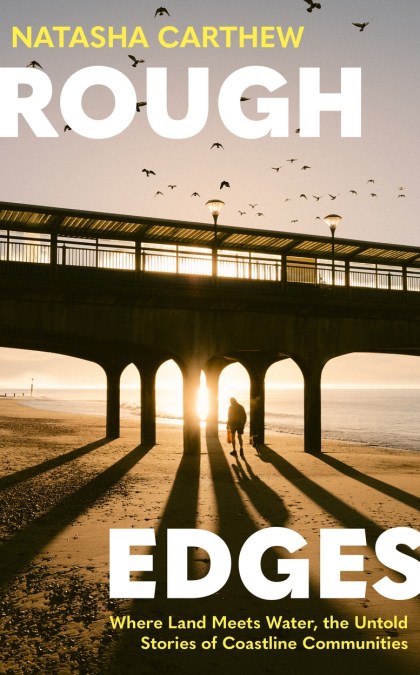
Rough Edges: where land meets water, the untold stories of coastline communities. Natasha Carthew, Sceptre (2026). Hardback £20, 288pp. ISBN 978-1399740586
 The publicity blurb for Rough Edges starts ‘Beyond the picture postcards, Britain’s coastal communities are suffering.’ And that’s why I offered to review a book essentially about socioeconomics, something that affects me, indeed all of us, but I didn’t think really engaged me. But those few words spoke to me as someone who grew up in such a community, who has lived in several others and visited many more. Furthermore, as an ecologist, to whom community means a very different thing, those words still ring very true in that scientific context.
This is not a nature book, whatever that means, but the author is clearly immersed and invested in the nature of the coast and takes comfort from it. But she sees beyond the chocolate box into the real life of zero-hour contracts servicing the transient whims of visitors, many of whom leave a lasting negative impact in terms of pollution, of removing essential resources (eg housing) from those bound by simple economics to the place, of fossilizing an expectation of coastal living, an expectation which probably never quite matched reality.
Such harking back to the ‘good old times’, whether real or imagined, is something that afflicts society almost everywhere, but for reasons she explores fully (mostly due to dissatisfaction sown by those engaged in self-serving divisive political projects) nowhere it seems is more vulnerable to having its collective views so manipulated than in coastal communities. Which is really rather disappointing given that the essential resilience of those living on the dynamic edgelands of our country should make them less prone to ‘mind control’. That resilience comes in no small part from acceptance of the value of looking beyond the horizon, for trade and transport, past the early cartographers’ dire warnings of ‘here there be dragons’!
It is here I start to read some parallels between human and nature communities. I delight in the plant and animals that thrive by the coast in spite of the chemical and energetic assaults of their environment. I marvel at the stories of migration, travel from distant shores. It is the stories of those survivors and wanderers that define the lure of the coast to me as a naturalist. And it is very much to the author’s credit that she has made me think hard about those parallels, however tenuous.
The language is lyrical and admirably robust, although what I feel is the over-repetition of the words ‘working class’ does risk the author’s well-argued and essential messages drifting into polemic. While it is important the voices of the ‘working class’ come to the fore and are heard by those who, like it or not, are assuming power over others, the inherent hostility of polemicism could work against the essential ‘coming together’ of the idea of community.
Again from the blurb: ‘Rough Edges is a rallying cry for the beauty and importance of our coast and its people.‘ I couldn’t agree more. Coastal humans and coastal wildlife alike need all the help, the friends in right places, that they can get. And this book should be an important contribution to that process.
First published by the British Naturalists’ Association